


Design Architect
Local Architect of Record
Contractor
Photography
American Institute of Architects San Francisco
SB Magazine (IAKS)
Baseball in the Dominican Republic has long operated as both culture and continuity, producing generations of players whose paths extend into the Major Leagues. For the San Francisco Giants, that history is reflected in an academy shaped by an existing site and a long-standing connection to the country.
Built on a site already defined by two existing diamonds, the project extends that condition into a campus organized through alignment and orientation—establishing a master plan that orders buildings, fields, and daily life into a coherent whole. With the addition of a third diamond, the layout establishes a clear relationship between buildings and the playing fields.
The campus is structured through the relationship of two primary buildings and a clear progression from public to private space. Positioned near the entry, the athletic and administrative building engages the three diamonds, forming a tight cluster that anchors the training environment. Beyond it, the residential and education building is set deeper within the site, establishing a more private domain organized around its courtyard.
This organization establishes a clear sequence across the site, moving from the more public, performance-oriented spaces near the entry to the quieter, more communal life of the residential courtyard.
Within the athletic and administrative building, entry, reception, and administrative functions are located at its eastern end, while the gym—with its full-height glass wall—is aligned on the central axis of the diamonds, establishing a strong visual connection to daily training. More private functions, including locker rooms and support spaces, are located toward the western end.
The residential and education building is organized into three wings, forming a courtyard that serves as the center of daily life—an outdoor room shaped as much by gathering and recreation as by study. Aligned with the primary diamond, the courtyard extends the relationship between interior life and the activity beyond, allowing the rhythms of training and daily life to remain in constant dialogue.
Social spaces are positioned along its edges to activate this central ground, including dining areas, informal gathering zones, and a covered outdoor room that recalls the open-air palapas found throughout the Dominican Republic. Together, these spaces support a range of daily and communal activities, allowing the courtyard to function as both a place of pause and a space of interaction, particularly in the evenings.
A continuous system of fly roofs extends across all buildings, forming a unifying architectural element and the primary environmental response. In a climate where solar gain is concentrated at the roof, these elevated planes shade both the buildings and the open spaces between them, while allowing heat to rise and dissipate above. Reading as broad horizontal planes set above the structures, they give the campus a distinct identity while substantially reducing heat gain and mechanical demand.
Material and environmental strategies are grounded in local practice. Buildings are narrow in section to promote cross ventilation, with operable openings on opposing sides of most spaces. Coralina limestone is used at the ground level, referencing its presence throughout the Dominican Republic—from utilitarian applications to civic plazas.
The residential building, in its organization, recalls the logic of a cloister—supporting a strong sense of community through proximity and shared space. At its open edge, the primary diamond becomes the focal point, reinforcing the connection between daily life and the central activity of the campus.
For many of the student athletes, this is the first time living and training away from home, and the architecture provides a clear and supportive framework for that transition.
Named for Felipe Alou, the academy carries forward a deeper connection between the Giants organization and the Dominican Republic—linking the history of the game to the next generation of players. The result is a campus defined by alignment, proximity, and shared space—where daily life is structured with clarity and the diamonds remain at the center of the collective experience.


Design Architect
Local Architect of Record
Contractor
Photography
American Institute of Architects San Francisco
SB Magazine (IAKS)
Baseball in the Dominican Republic has long operated as both culture and continuity, producing generations of players whose paths extend into the Major Leagues. For the San Francisco Giants, that history is reflected in an academy shaped by an existing site and a long-standing connection to the country.
Built on a site already defined by two existing diamonds, the project extends that condition into a campus organized through alignment and orientation—establishing a master plan that orders buildings, fields, and daily life into a coherent whole. With the addition of a third diamond, the layout establishes a clear relationship between buildings and the playing fields.
The campus is structured through the relationship of two primary buildings and a clear progression from public to private space. Positioned near the entry, the athletic and administrative building engages the three diamonds, forming a tight cluster that anchors the training environment. Beyond it, the residential and education building is set deeper within the site, establishing a more private domain organized around its courtyard.
This organization establishes a clear sequence across the site, moving from the more public, performance-oriented spaces near the entry to the quieter, more communal life of the residential courtyard.
Within the athletic and administrative building, entry, reception, and administrative functions are located at its eastern end, while the gym—with its full-height glass wall—is aligned on the central axis of the diamonds, establishing a strong visual connection to daily training. More private functions, including locker rooms and support spaces, are located toward the western end.
The residential and education building is organized into three wings, forming a courtyard that serves as the center of daily life—an outdoor room shaped as much by gathering and recreation as by study. Aligned with the primary diamond, the courtyard extends the relationship between interior life and the activity beyond, allowing the rhythms of training and daily life to remain in constant dialogue.
Social spaces are positioned along its edges to activate this central ground, including dining areas, informal gathering zones, and a covered outdoor room that recalls the open-air palapas found throughout the Dominican Republic. Together, these spaces support a range of daily and communal activities, allowing the courtyard to function as both a place of pause and a space of interaction, particularly in the evenings.
A continuous system of fly roofs extends across all buildings, forming a unifying architectural element and the primary environmental response. In a climate where solar gain is concentrated at the roof, these elevated planes shade both the buildings and the open spaces between them, while allowing heat to rise and dissipate above. Reading as broad horizontal planes set above the structures, they give the campus a distinct identity while substantially reducing heat gain and mechanical demand.
Material and environmental strategies are grounded in local practice. Buildings are narrow in section to promote cross ventilation, with operable openings on opposing sides of most spaces. Coralina limestone is used at the ground level, referencing its presence throughout the Dominican Republic—from utilitarian applications to civic plazas.
The residential building, in its organization, recalls the logic of a cloister—supporting a strong sense of community through proximity and shared space. At its open edge, the primary diamond becomes the focal point, reinforcing the connection between daily life and the central activity of the campus.
For many of the student athletes, this is the first time living and training away from home, and the architecture provides a clear and supportive framework for that transition.
Named for Felipe Alou, the academy carries forward a deeper connection between the Giants organization and the Dominican Republic—linking the history of the game to the next generation of players. The result is a campus defined by alignment, proximity, and shared space—where daily life is structured with clarity and the diamonds remain at the center of the collective experience.


Design Architect
Local Architect of Record
Contractor
Photography
American Institute of Architects San Francisco
SB Magazine (IAKS)
Baseball in the Dominican Republic has long operated as both culture and continuity, producing generations of players whose paths extend into the Major Leagues. For the San Francisco Giants, that history is reflected in an academy shaped by an existing site and a long-standing connection to the country.
Built on a site already defined by two existing diamonds, the project extends that condition into a campus organized through alignment and orientation—establishing a master plan that orders buildings, fields, and daily life into a coherent whole. With the addition of a third diamond, the layout establishes a clear relationship between buildings and the playing fields.
The campus is structured through the relationship of two primary buildings and a clear progression from public to private space. Positioned near the entry, the athletic and administrative building engages the three diamonds, forming a tight cluster that anchors the training environment. Beyond it, the residential and education building is set deeper within the site, establishing a more private domain organized around its courtyard.
This organization establishes a clear sequence across the site, moving from the more public, performance-oriented spaces near the entry to the quieter, more communal life of the residential courtyard.
Within the athletic and administrative building, entry, reception, and administrative functions are located at its eastern end, while the gym—with its full-height glass wall—is aligned on the central axis of the diamonds, establishing a strong visual connection to daily training. More private functions, including locker rooms and support spaces, are located toward the western end.
The residential and education building is organized into three wings, forming a courtyard that serves as the center of daily life—an outdoor room shaped as much by gathering and recreation as by study. Aligned with the primary diamond, the courtyard extends the relationship between interior life and the activity beyond, allowing the rhythms of training and daily life to remain in constant dialogue.
Social spaces are positioned along its edges to activate this central ground, including dining areas, informal gathering zones, and a covered outdoor room that recalls the open-air palapas found throughout the Dominican Republic. Together, these spaces support a range of daily and communal activities, allowing the courtyard to function as both a place of pause and a space of interaction, particularly in the evenings.
A continuous system of fly roofs extends across all buildings, forming a unifying architectural element and the primary environmental response. In a climate where solar gain is concentrated at the roof, these elevated planes shade both the buildings and the open spaces between them, while allowing heat to rise and dissipate above. Reading as broad horizontal planes set above the structures, they give the campus a distinct identity while substantially reducing heat gain and mechanical demand.
Material and environmental strategies are grounded in local practice. Buildings are narrow in section to promote cross ventilation, with operable openings on opposing sides of most spaces. Coralina limestone is used at the ground level, referencing its presence throughout the Dominican Republic—from utilitarian applications to civic plazas.
The residential building, in its organization, recalls the logic of a cloister—supporting a strong sense of community through proximity and shared space. At its open edge, the primary diamond becomes the focal point, reinforcing the connection between daily life and the central activity of the campus.
For many of the student athletes, this is the first time living and training away from home, and the architecture provides a clear and supportive framework for that transition.
Named for Felipe Alou, the academy carries forward a deeper connection between the Giants organization and the Dominican Republic—linking the history of the game to the next generation of players. The result is a campus defined by alignment, proximity, and shared space—where daily life is structured with clarity and the diamonds remain at the center of the collective experience.


Design Architect
Local Architect of Record
Contractor
Photography
American Institute of Architects San Francisco
SB Magazine (IAKS)
Baseball in the Dominican Republic has long operated as both culture and continuity, producing generations of players whose paths extend into the Major Leagues. For the San Francisco Giants, that history is reflected in an academy shaped by an existing site and a long-standing connection to the country.
Built on a site already defined by two existing diamonds, the project extends that condition into a campus organized through alignment and orientation—establishing a master plan that orders buildings, fields, and daily life into a coherent whole. With the addition of a third diamond, the layout establishes a clear relationship between buildings and the playing fields.
The campus is structured through the relationship of two primary buildings and a clear progression from public to private space. Positioned near the entry, the athletic and administrative building engages the three diamonds, forming a tight cluster that anchors the training environment. Beyond it, the residential and education building is set deeper within the site, establishing a more private domain organized around its courtyard.
This organization establishes a clear sequence across the site, moving from the more public, performance-oriented spaces near the entry to the quieter, more communal life of the residential courtyard.
Within the athletic and administrative building, entry, reception, and administrative functions are located at its eastern end, while the gym—with its full-height glass wall—is aligned on the central axis of the diamonds, establishing a strong visual connection to daily training. More private functions, including locker rooms and support spaces, are located toward the western end.
The residential and education building is organized into three wings, forming a courtyard that serves as the center of daily life—an outdoor room shaped as much by gathering and recreation as by study. Aligned with the primary diamond, the courtyard extends the relationship between interior life and the activity beyond, allowing the rhythms of training and daily life to remain in constant dialogue.
Social spaces are positioned along its edges to activate this central ground, including dining areas, informal gathering zones, and a covered outdoor room that recalls the open-air palapas found throughout the Dominican Republic. Together, these spaces support a range of daily and communal activities, allowing the courtyard to function as both a place of pause and a space of interaction, particularly in the evenings.
A continuous system of fly roofs extends across all buildings, forming a unifying architectural element and the primary environmental response. In a climate where solar gain is concentrated at the roof, these elevated planes shade both the buildings and the open spaces between them, while allowing heat to rise and dissipate above. Reading as broad horizontal planes set above the structures, they give the campus a distinct identity while substantially reducing heat gain and mechanical demand.
Material and environmental strategies are grounded in local practice. Buildings are narrow in section to promote cross ventilation, with operable openings on opposing sides of most spaces. Coralina limestone is used at the ground level, referencing its presence throughout the Dominican Republic—from utilitarian applications to civic plazas.
The residential building, in its organization, recalls the logic of a cloister—supporting a strong sense of community through proximity and shared space. At its open edge, the primary diamond becomes the focal point, reinforcing the connection between daily life and the central activity of the campus.
For many of the student athletes, this is the first time living and training away from home, and the architecture provides a clear and supportive framework for that transition.
Named for Felipe Alou, the academy carries forward a deeper connection between the Giants organization and the Dominican Republic—linking the history of the game to the next generation of players. The result is a campus defined by alignment, proximity, and shared space—where daily life is structured with clarity and the diamonds remain at the center of the collective experience.


Design Architect
Local Architect of Record
Contractor
Photography
American Institute of Architects San Francisco
SB Magazine (IAKS)
Baseball in the Dominican Republic has long operated as both culture and continuity, producing generations of players whose paths extend into the Major Leagues. For the San Francisco Giants, that history is reflected in an academy shaped by an existing site and a long-standing connection to the country.
Built on a site already defined by two existing diamonds, the project extends that condition into a campus organized through alignment and orientation—establishing a master plan that orders buildings, fields, and daily life into a coherent whole. With the addition of a third diamond, the layout establishes a clear relationship between buildings and the playing fields.
The campus is structured through the relationship of two primary buildings and a clear progression from public to private space. Positioned near the entry, the athletic and administrative building engages the three diamonds, forming a tight cluster that anchors the training environment. Beyond it, the residential and education building is set deeper within the site, establishing a more private domain organized around its courtyard.
This organization establishes a clear sequence across the site, moving from the more public, performance-oriented spaces near the entry to the quieter, more communal life of the residential courtyard.
Within the athletic and administrative building, entry, reception, and administrative functions are located at its eastern end, while the gym—with its full-height glass wall—is aligned on the central axis of the diamonds, establishing a strong visual connection to daily training. More private functions, including locker rooms and support spaces, are located toward the western end.
The residential and education building is organized into three wings, forming a courtyard that serves as the center of daily life—an outdoor room shaped as much by gathering and recreation as by study. Aligned with the primary diamond, the courtyard extends the relationship between interior life and the activity beyond, allowing the rhythms of training and daily life to remain in constant dialogue.
Social spaces are positioned along its edges to activate this central ground, including dining areas, informal gathering zones, and a covered outdoor room that recalls the open-air palapas found throughout the Dominican Republic. Together, these spaces support a range of daily and communal activities, allowing the courtyard to function as both a place of pause and a space of interaction, particularly in the evenings.
A continuous system of fly roofs extends across all buildings, forming a unifying architectural element and the primary environmental response. In a climate where solar gain is concentrated at the roof, these elevated planes shade both the buildings and the open spaces between them, while allowing heat to rise and dissipate above. Reading as broad horizontal planes set above the structures, they give the campus a distinct identity while substantially reducing heat gain and mechanical demand.
Material and environmental strategies are grounded in local practice. Buildings are narrow in section to promote cross ventilation, with operable openings on opposing sides of most spaces. Coralina limestone is used at the ground level, referencing its presence throughout the Dominican Republic—from utilitarian applications to civic plazas.
The residential building, in its organization, recalls the logic of a cloister—supporting a strong sense of community through proximity and shared space. At its open edge, the primary diamond becomes the focal point, reinforcing the connection between daily life and the central activity of the campus.
For many of the student athletes, this is the first time living and training away from home, and the architecture provides a clear and supportive framework for that transition.
Named for Felipe Alou, the academy carries forward a deeper connection between the Giants organization and the Dominican Republic—linking the history of the game to the next generation of players. The result is a campus defined by alignment, proximity, and shared space—where daily life is structured with clarity and the diamonds remain at the center of the collective experience.


Design Architect
Local Architect of Record
Contractor
Photography
American Institute of Architects San Francisco
SB Magazine (IAKS)
Baseball in the Dominican Republic has long operated as both culture and continuity, producing generations of players whose paths extend into the Major Leagues. For the San Francisco Giants, that history is reflected in an academy shaped by an existing site and a long-standing connection to the country.
Built on a site already defined by two existing diamonds, the project extends that condition into a campus organized through alignment and orientation—establishing a master plan that orders buildings, fields, and daily life into a coherent whole. With the addition of a third diamond, the layout establishes a clear relationship between buildings and the playing fields.
The campus is structured through the relationship of two primary buildings and a clear progression from public to private space. Positioned near the entry, the athletic and administrative building engages the three diamonds, forming a tight cluster that anchors the training environment. Beyond it, the residential and education building is set deeper within the site, establishing a more private domain organized around its courtyard.
This organization establishes a clear sequence across the site, moving from the more public, performance-oriented spaces near the entry to the quieter, more communal life of the residential courtyard.
Within the athletic and administrative building, entry, reception, and administrative functions are located at its eastern end, while the gym—with its full-height glass wall—is aligned on the central axis of the diamonds, establishing a strong visual connection to daily training. More private functions, including locker rooms and support spaces, are located toward the western end.
The residential and education building is organized into three wings, forming a courtyard that serves as the center of daily life—an outdoor room shaped as much by gathering and recreation as by study. Aligned with the primary diamond, the courtyard extends the relationship between interior life and the activity beyond, allowing the rhythms of training and daily life to remain in constant dialogue.
Social spaces are positioned along its edges to activate this central ground, including dining areas, informal gathering zones, and a covered outdoor room that recalls the open-air palapas found throughout the Dominican Republic. Together, these spaces support a range of daily and communal activities, allowing the courtyard to function as both a place of pause and a space of interaction, particularly in the evenings.
A continuous system of fly roofs extends across all buildings, forming a unifying architectural element and the primary environmental response. In a climate where solar gain is concentrated at the roof, these elevated planes shade both the buildings and the open spaces between them, while allowing heat to rise and dissipate above. Reading as broad horizontal planes set above the structures, they give the campus a distinct identity while substantially reducing heat gain and mechanical demand.
Material and environmental strategies are grounded in local practice. Buildings are narrow in section to promote cross ventilation, with operable openings on opposing sides of most spaces. Coralina limestone is used at the ground level, referencing its presence throughout the Dominican Republic—from utilitarian applications to civic plazas.
The residential building, in its organization, recalls the logic of a cloister—supporting a strong sense of community through proximity and shared space. At its open edge, the primary diamond becomes the focal point, reinforcing the connection between daily life and the central activity of the campus.
For many of the student athletes, this is the first time living and training away from home, and the architecture provides a clear and supportive framework for that transition.
Named for Felipe Alou, the academy carries forward a deeper connection between the Giants organization and the Dominican Republic—linking the history of the game to the next generation of players. The result is a campus defined by alignment, proximity, and shared space—where daily life is structured with clarity and the diamonds remain at the center of the collective experience.




Design Architect
Local Architect of Record
Contractor
Photography
American Institute of Architects San Francisco
SB Magazine (IAKS)
Baseball in the Dominican Republic has long operated as both culture and continuity, producing generations of players whose paths extend into the Major Leagues. For the San Francisco Giants, that history is reflected in an academy shaped by an existing site and a long-standing connection to the country.
Built on a site already defined by two existing diamonds, the project extends that condition into a campus organized through alignment and orientation—establishing a master plan that orders buildings, fields, and daily life into a coherent whole. With the addition of a third diamond, the layout establishes a clear relationship between buildings and the playing fields.
The campus is structured through the relationship of two primary buildings and a clear progression from public to private space. Positioned near the entry, the athletic and administrative building engages the three diamonds, forming a tight cluster that anchors the training environment. Beyond it, the residential and education building is set deeper within the site, establishing a more private domain organized around its courtyard.
This organization establishes a clear sequence across the site, moving from the more public, performance-oriented spaces near the entry to the quieter, more communal life of the residential courtyard.
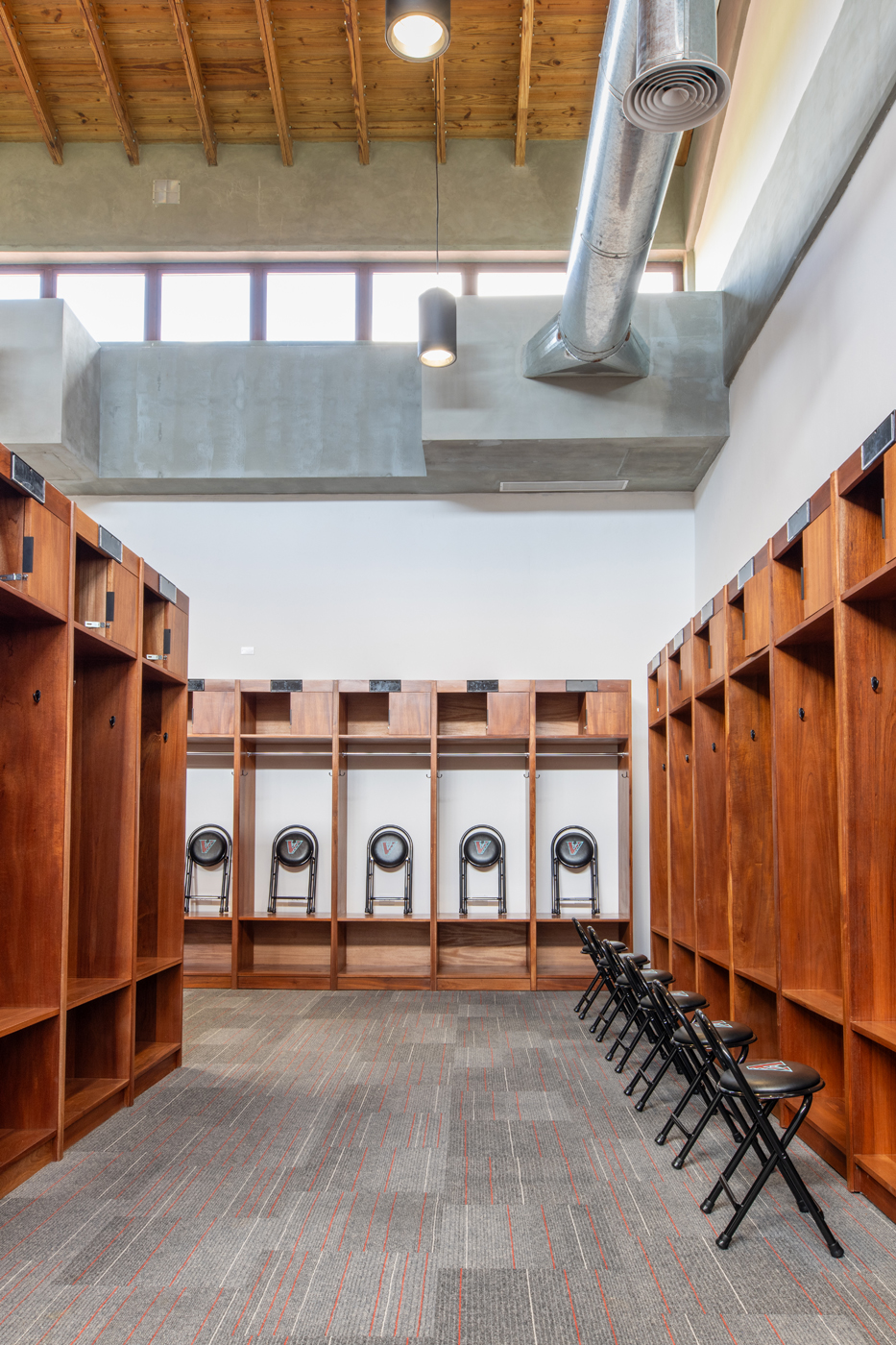
Within the athletic and administrative building, entry, reception, and administrative functions are located at its eastern end, while the gym—with its full-height glass wall—is aligned on the central axis of the diamonds, establishing a strong visual connection to daily training. More private functions, including locker rooms and support spaces, are located toward the western end.
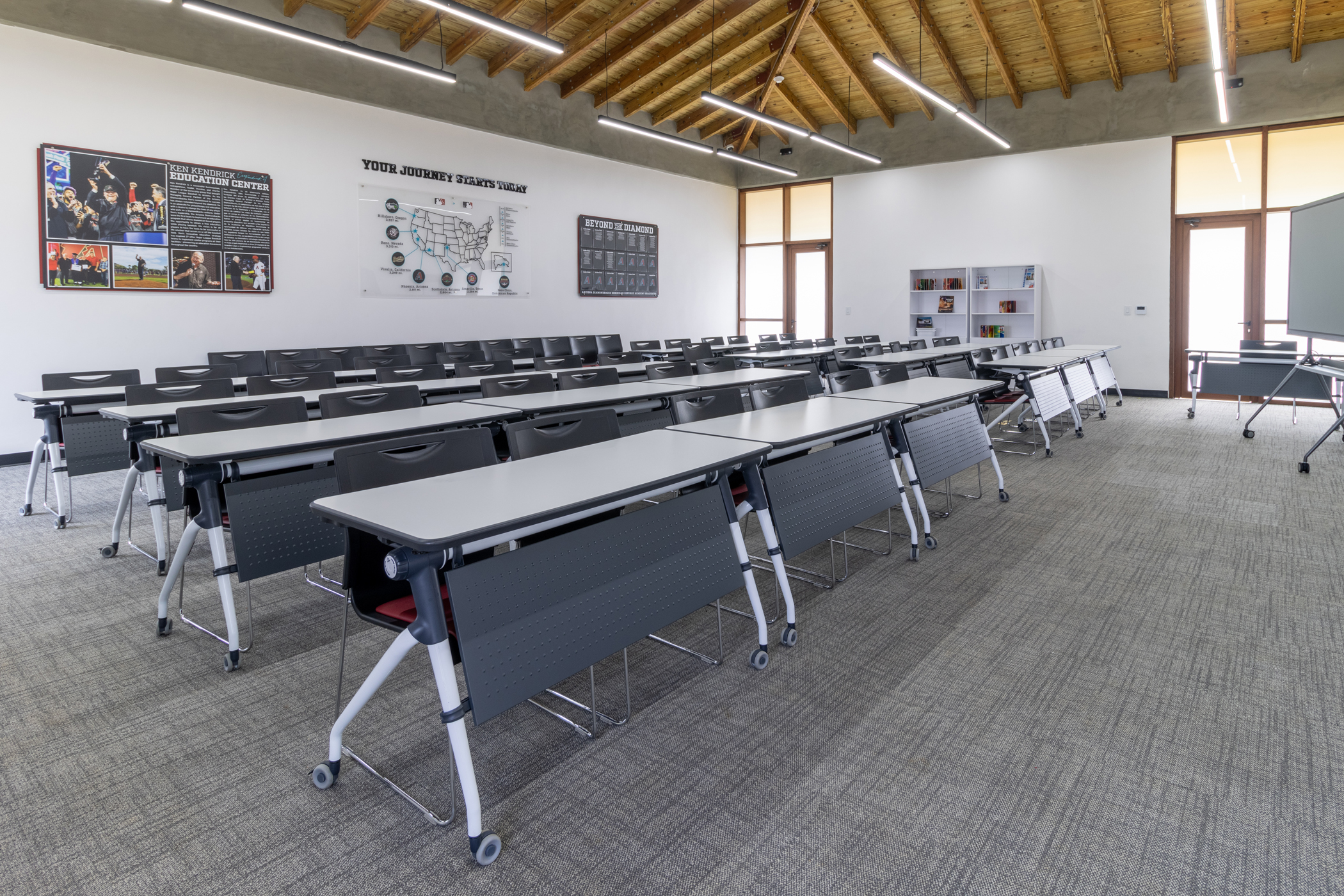
The residential and education building is organized into three wings, forming a courtyard that serves as the center of daily life—an outdoor room shaped as much by gathering and recreation as by study. Aligned with the primary diamond, the courtyard extends the relationship between interior life and the activity beyond, allowing the rhythms of training and daily life to remain in constant dialogue.
Social spaces are positioned along its edges to activate this central ground, including dining areas, informal gathering zones, and a covered outdoor room that recalls the open-air palapas found throughout the Dominican Republic. Together, these spaces support a range of daily and communal activities, allowing the courtyard to function as both a place of pause and a space of interaction, particularly in the evenings.
A continuous system of fly roofs extends across all buildings, forming a unifying architectural element and the primary environmental response. In a climate where solar gain is concentrated at the roof, these elevated planes shade both the buildings and the open spaces between them, while allowing heat to rise and dissipate above. Reading as broad horizontal planes set above the structures, they give the campus a distinct identity while substantially reducing heat gain and mechanical demand.
Material and environmental strategies are grounded in local practice. Buildings are narrow in section to promote cross ventilation, with operable openings on opposing sides of most spaces. Coralina limestone is used at the ground level, referencing its presence throughout the Dominican Republic—from utilitarian applications to civic plazas.
The residential building, in its organization, recalls the logic of a cloister—supporting a strong sense of community through proximity and shared space. At its open edge, the primary diamond becomes the focal point, reinforcing the connection between daily life and the central activity of the campus.
For many of the student athletes, this is the first time living and training away from home, and the architecture provides a clear and supportive framework for that transition.
Named for Felipe Alou, the academy carries forward a deeper connection between the Giants organization and the Dominican Republic—linking the history of the game to the next generation of players. The result is a campus defined by alignment, proximity, and shared space—where daily life is structured with clarity and the diamonds remain at the center of the collective experience.


Design Architect
Local Architect of Record
Contractor
Photography
American Institute of Architects San Francisco
SB Magazine (IAKS)
Baseball in the Dominican Republic has long operated as both culture and continuity, producing generations of players whose paths extend into the Major Leagues. For the San Francisco Giants, that history is reflected in an academy shaped by an existing site and a long-standing connection to the country.
Built on a site already defined by two existing diamonds, the project extends that condition into a campus organized through alignment and orientation—establishing a master plan that orders buildings, fields, and daily life into a coherent whole. With the addition of a third diamond, the layout establishes a clear relationship between buildings and the playing fields.
The campus is structured through the relationship of two primary buildings and a clear progression from public to private space. Positioned near the entry, the athletic and administrative building engages the three diamonds, forming a tight cluster that anchors the training environment. Beyond it, the residential and education building is set deeper within the site, establishing a more private domain organized around its courtyard.
This organization establishes a clear sequence across the site, moving from the more public, performance-oriented spaces near the entry to the quieter, more communal life of the residential courtyard.
Within the athletic and administrative building, entry, reception, and administrative functions are located at its eastern end, while the gym—with its full-height glass wall—is aligned on the central axis of the diamonds, establishing a strong visual connection to daily training. More private functions, including locker rooms and support spaces, are located toward the western end.
The residential and education building is organized into three wings, forming a courtyard that serves as the center of daily life—an outdoor room shaped as much by gathering and recreation as by study. Aligned with the primary diamond, the courtyard extends the relationship between interior life and the activity beyond, allowing the rhythms of training and daily life to remain in constant dialogue.
Social spaces are positioned along its edges to activate this central ground, including dining areas, informal gathering zones, and a covered outdoor room that recalls the open-air palapas found throughout the Dominican Republic. Together, these spaces support a range of daily and communal activities, allowing the courtyard to function as both a place of pause and a space of interaction, particularly in the evenings.
A continuous system of fly roofs extends across all buildings, forming a unifying architectural element and the primary environmental response. In a climate where solar gain is concentrated at the roof, these elevated planes shade both the buildings and the open spaces between them, while allowing heat to rise and dissipate above. Reading as broad horizontal planes set above the structures, they give the campus a distinct identity while substantially reducing heat gain and mechanical demand.
Material and environmental strategies are grounded in local practice. Buildings are narrow in section to promote cross ventilation, with operable openings on opposing sides of most spaces. Coralina limestone is used at the ground level, referencing its presence throughout the Dominican Republic—from utilitarian applications to civic plazas.
The residential building, in its organization, recalls the logic of a cloister—supporting a strong sense of community through proximity and shared space. At its open edge, the primary diamond becomes the focal point, reinforcing the connection between daily life and the central activity of the campus.
For many of the student athletes, this is the first time living and training away from home, and the architecture provides a clear and supportive framework for that transition.
Named for Felipe Alou, the academy carries forward a deeper connection between the Giants organization and the Dominican Republic—linking the history of the game to the next generation of players. The result is a campus defined by alignment, proximity, and shared space—where daily life is structured with clarity and the diamonds remain at the center of the collective experience.


Design Architect
Local Architect of Record
Contractor
Photography
American Institute of Architects San Francisco
SB Magazine (IAKS)
Baseball in the Dominican Republic has long operated as both culture and continuity, producing generations of players whose paths extend into the Major Leagues. For the San Francisco Giants, that history is reflected in an academy shaped by an existing site and a long-standing connection to the country.
Built on a site already defined by two existing diamonds, the project extends that condition into a campus organized through alignment and orientation—establishing a master plan that orders buildings, fields, and daily life into a coherent whole. With the addition of a third diamond, the layout establishes a clear relationship between buildings and the playing fields.
The campus is structured through the relationship of two primary buildings and a clear progression from public to private space. Positioned near the entry, the athletic and administrative building engages the three diamonds, forming a tight cluster that anchors the training environment. Beyond it, the residential and education building is set deeper within the site, establishing a more private domain organized around its courtyard.
This organization establishes a clear sequence across the site, moving from the more public, performance-oriented spaces near the entry to the quieter, more communal life of the residential courtyard.
Within the athletic and administrative building, entry, reception, and administrative functions are located at its eastern end, while the gym—with its full-height glass wall—is aligned on the central axis of the diamonds, establishing a strong visual connection to daily training. More private functions, including locker rooms and support spaces, are located toward the western end.
The residential and education building is organized into three wings, forming a courtyard that serves as the center of daily life—an outdoor room shaped as much by gathering and recreation as by study. Aligned with the primary diamond, the courtyard extends the relationship between interior life and the activity beyond, allowing the rhythms of training and daily life to remain in constant dialogue.
Social spaces are positioned along its edges to activate this central ground, including dining areas, informal gathering zones, and a covered outdoor room that recalls the open-air palapas found throughout the Dominican Republic. Together, these spaces support a range of daily and communal activities, allowing the courtyard to function as both a place of pause and a space of interaction, particularly in the evenings.
A continuous system of fly roofs extends across all buildings, forming a unifying architectural element and the primary environmental response. In a climate where solar gain is concentrated at the roof, these elevated planes shade both the buildings and the open spaces between them, while allowing heat to rise and dissipate above. Reading as broad horizontal planes set above the structures, they give the campus a distinct identity while substantially reducing heat gain and mechanical demand.
Material and environmental strategies are grounded in local practice. Buildings are narrow in section to promote cross ventilation, with operable openings on opposing sides of most spaces. Coralina limestone is used at the ground level, referencing its presence throughout the Dominican Republic—from utilitarian applications to civic plazas.
The residential building, in its organization, recalls the logic of a cloister—supporting a strong sense of community through proximity and shared space. At its open edge, the primary diamond becomes the focal point, reinforcing the connection between daily life and the central activity of the campus.
For many of the student athletes, this is the first time living and training away from home, and the architecture provides a clear and supportive framework for that transition.
Named for Felipe Alou, the academy carries forward a deeper connection between the Giants organization and the Dominican Republic—linking the history of the game to the next generation of players. The result is a campus defined by alignment, proximity, and shared space—where daily life is structured with clarity and the diamonds remain at the center of the collective experience.


Design Architect
Local Architect of Record
Contractor
Photography
American Institute of Architects San Francisco
SB Magazine (IAKS)
Baseball in the Dominican Republic has long operated as both culture and continuity, producing generations of players whose paths extend into the Major Leagues. For the San Francisco Giants, that history is reflected in an academy shaped by an existing site and a long-standing connection to the country.
Built on a site already defined by two existing diamonds, the project extends that condition into a campus organized through alignment and orientation—establishing a master plan that orders buildings, fields, and daily life into a coherent whole. With the addition of a third diamond, the layout establishes a clear relationship between buildings and the playing fields.
The campus is structured through the relationship of two primary buildings and a clear progression from public to private space. Positioned near the entry, the athletic and administrative building engages the three diamonds, forming a tight cluster that anchors the training environment. Beyond it, the residential and education building is set deeper within the site, establishing a more private domain organized around its courtyard.
This organization establishes a clear sequence across the site, moving from the more public, performance-oriented spaces near the entry to the quieter, more communal life of the residential courtyard.
Within the athletic and administrative building, entry, reception, and administrative functions are located at its eastern end, while the gym—with its full-height glass wall—is aligned on the central axis of the diamonds, establishing a strong visual connection to daily training. More private functions, including locker rooms and support spaces, are located toward the western end.
The residential and education building is organized into three wings, forming a courtyard that serves as the center of daily life—an outdoor room shaped as much by gathering and recreation as by study. Aligned with the primary diamond, the courtyard extends the relationship between interior life and the activity beyond, allowing the rhythms of training and daily life to remain in constant dialogue.
Social spaces are positioned along its edges to activate this central ground, including dining areas, informal gathering zones, and a covered outdoor room that recalls the open-air palapas found throughout the Dominican Republic. Together, these spaces support a range of daily and communal activities, allowing the courtyard to function as both a place of pause and a space of interaction, particularly in the evenings.
A continuous system of fly roofs extends across all buildings, forming a unifying architectural element and the primary environmental response. In a climate where solar gain is concentrated at the roof, these elevated planes shade both the buildings and the open spaces between them, while allowing heat to rise and dissipate above. Reading as broad horizontal planes set above the structures, they give the campus a distinct identity while substantially reducing heat gain and mechanical demand.
Material and environmental strategies are grounded in local practice. Buildings are narrow in section to promote cross ventilation, with operable openings on opposing sides of most spaces. Coralina limestone is used at the ground level, referencing its presence throughout the Dominican Republic—from utilitarian applications to civic plazas.
The residential building, in its organization, recalls the logic of a cloister—supporting a strong sense of community through proximity and shared space. At its open edge, the primary diamond becomes the focal point, reinforcing the connection between daily life and the central activity of the campus.
For many of the student athletes, this is the first time living and training away from home, and the architecture provides a clear and supportive framework for that transition.
Named for Felipe Alou, the academy carries forward a deeper connection between the Giants organization and the Dominican Republic—linking the history of the game to the next generation of players. The result is a campus defined by alignment, proximity, and shared space—where daily life is structured with clarity and the diamonds remain at the center of the collective experience.


Design Architect
Local Architect of Record
Contractor
Photography
American Institute of Architects San Francisco
SB Magazine (IAKS)
Baseball in the Dominican Republic has long operated as both culture and continuity, producing generations of players whose paths extend into the Major Leagues. For the San Francisco Giants, that history is reflected in an academy shaped by an existing site and a long-standing connection to the country.
Built on a site already defined by two existing diamonds, the project extends that condition into a campus organized through alignment and orientation—establishing a master plan that orders buildings, fields, and daily life into a coherent whole. With the addition of a third diamond, the layout establishes a clear relationship between buildings and the playing fields.
The campus is structured through the relationship of two primary buildings and a clear progression from public to private space. Positioned near the entry, the athletic and administrative building engages the three diamonds, forming a tight cluster that anchors the training environment. Beyond it, the residential and education building is set deeper within the site, establishing a more private domain organized around its courtyard.
This organization establishes a clear sequence across the site, moving from the more public, performance-oriented spaces near the entry to the quieter, more communal life of the residential courtyard.
Within the athletic and administrative building, entry, reception, and administrative functions are located at its eastern end, while the gym—with its full-height glass wall—is aligned on the central axis of the diamonds, establishing a strong visual connection to daily training. More private functions, including locker rooms and support spaces, are located toward the western end.
The residential and education building is organized into three wings, forming a courtyard that serves as the center of daily life—an outdoor room shaped as much by gathering and recreation as by study. Aligned with the primary diamond, the courtyard extends the relationship between interior life and the activity beyond, allowing the rhythms of training and daily life to remain in constant dialogue.
Social spaces are positioned along its edges to activate this central ground, including dining areas, informal gathering zones, and a covered outdoor room that recalls the open-air palapas found throughout the Dominican Republic. Together, these spaces support a range of daily and communal activities, allowing the courtyard to function as both a place of pause and a space of interaction, particularly in the evenings.
A continuous system of fly roofs extends across all buildings, forming a unifying architectural element and the primary environmental response. In a climate where solar gain is concentrated at the roof, these elevated planes shade both the buildings and the open spaces between them, while allowing heat to rise and dissipate above. Reading as broad horizontal planes set above the structures, they give the campus a distinct identity while substantially reducing heat gain and mechanical demand.
Material and environmental strategies are grounded in local practice. Buildings are narrow in section to promote cross ventilation, with operable openings on opposing sides of most spaces. Coralina limestone is used at the ground level, referencing its presence throughout the Dominican Republic—from utilitarian applications to civic plazas.
The residential building, in its organization, recalls the logic of a cloister—supporting a strong sense of community through proximity and shared space. At its open edge, the primary diamond becomes the focal point, reinforcing the connection between daily life and the central activity of the campus.
For many of the student athletes, this is the first time living and training away from home, and the architecture provides a clear and supportive framework for that transition.
Named for Felipe Alou, the academy carries forward a deeper connection between the Giants organization and the Dominican Republic—linking the history of the game to the next generation of players. The result is a campus defined by alignment, proximity, and shared space—where daily life is structured with clarity and the diamonds remain at the center of the collective experience.


Design Architect
Local Architect of Record
Contractor
Photography
American Institute of Architects San Francisco
SB Magazine (IAKS)
Baseball in the Dominican Republic has long operated as both culture and continuity, producing generations of players whose paths extend into the Major Leagues. For the San Francisco Giants, that history is reflected in an academy shaped by an existing site and a long-standing connection to the country.
Built on a site already defined by two existing diamonds, the project extends that condition into a campus organized through alignment and orientation—establishing a master plan that orders buildings, fields, and daily life into a coherent whole. With the addition of a third diamond, the layout establishes a clear relationship between buildings and the playing fields.
The campus is structured through the relationship of two primary buildings and a clear progression from public to private space. Positioned near the entry, the athletic and administrative building engages the three diamonds, forming a tight cluster that anchors the training environment. Beyond it, the residential and education building is set deeper within the site, establishing a more private domain organized around its courtyard.
This organization establishes a clear sequence across the site, moving from the more public, performance-oriented spaces near the entry to the quieter, more communal life of the residential courtyard.
Within the athletic and administrative building, entry, reception, and administrative functions are located at its eastern end, while the gym—with its full-height glass wall—is aligned on the central axis of the diamonds, establishing a strong visual connection to daily training. More private functions, including locker rooms and support spaces, are located toward the western end.
The residential and education building is organized into three wings, forming a courtyard that serves as the center of daily life—an outdoor room shaped as much by gathering and recreation as by study. Aligned with the primary diamond, the courtyard extends the relationship between interior life and the activity beyond, allowing the rhythms of training and daily life to remain in constant dialogue.
Social spaces are positioned along its edges to activate this central ground, including dining areas, informal gathering zones, and a covered outdoor room that recalls the open-air palapas found throughout the Dominican Republic. Together, these spaces support a range of daily and communal activities, allowing the courtyard to function as both a place of pause and a space of interaction, particularly in the evenings.
A continuous system of fly roofs extends across all buildings, forming a unifying architectural element and the primary environmental response. In a climate where solar gain is concentrated at the roof, these elevated planes shade both the buildings and the open spaces between them, while allowing heat to rise and dissipate above. Reading as broad horizontal planes set above the structures, they give the campus a distinct identity while substantially reducing heat gain and mechanical demand.
Material and environmental strategies are grounded in local practice. Buildings are narrow in section to promote cross ventilation, with operable openings on opposing sides of most spaces. Coralina limestone is used at the ground level, referencing its presence throughout the Dominican Republic—from utilitarian applications to civic plazas.
The residential building, in its organization, recalls the logic of a cloister—supporting a strong sense of community through proximity and shared space. At its open edge, the primary diamond becomes the focal point, reinforcing the connection between daily life and the central activity of the campus.
For many of the student athletes, this is the first time living and training away from home, and the architecture provides a clear and supportive framework for that transition.
Named for Felipe Alou, the academy carries forward a deeper connection between the Giants organization and the Dominican Republic—linking the history of the game to the next generation of players. The result is a campus defined by alignment, proximity, and shared space—where daily life is structured with clarity and the diamonds remain at the center of the collective experience.